Barcelona Beyond Gaudí: Neighborhoods, Markets and a Real Route
The short answer: start with Barcelona's other great Modernista architect, Lluís Domènech i Montaner, at the Palau de la Música Catalana and Sant Pau. Then go underground to walk through Roman Barcino at the city history museum, shop the markets neighbors actually use (Santa Caterina, Sant Antoni, Llibertat), and give your evenings to Gràcia's squares and Poble-sec's pintxo street. For Sagrada Família, Park Güell and the other classics, see our Barcelona guide. This one covers everything else.
Who should you see in Barcelona besides Gaudí?
Short answer: Domènech i Montaner. His two masterpieces became UNESCO World Heritage Sites together in 1997, and they're the natural next step after Gaudí.
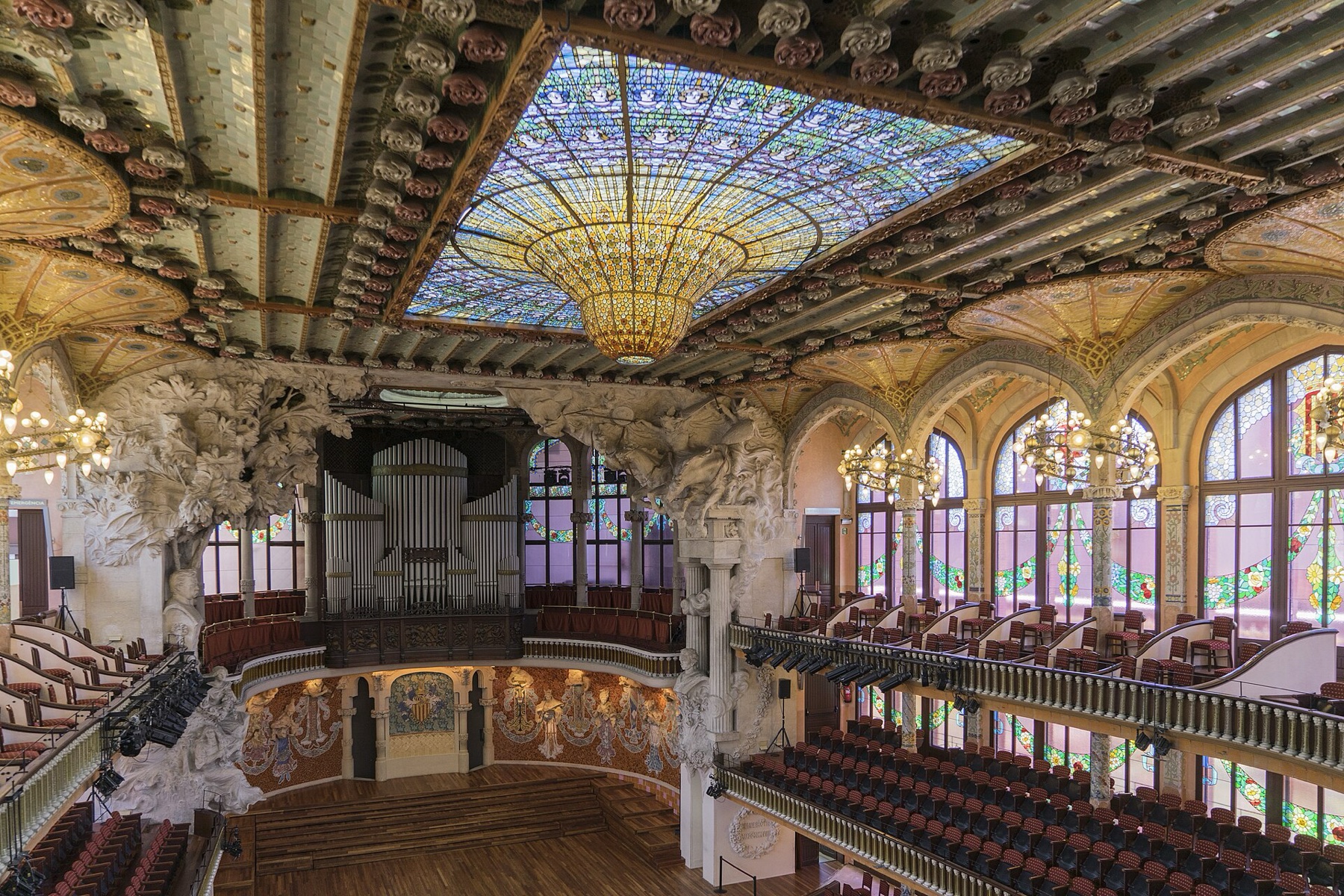
- Palau de la Música Catalana. A concert hall built from 1905 to 1908, with a stained-glass skylight whose golden inverted dome hangs over the stage. Go if you love color and don't mind excess. Visits run daily from about 9am to 3:30pm. Guided tours last about 50 minutes, and current listings range from 20 to 24 euros, with self-guided visits a little less, so check the official box office. One guide says the light through the glass is at its peak from 9am to 11am. For the full effect, come back for a concert: Palau 100 and Palau Cambra tickets start from about 20 euros.
- Sant Pau Recinte Modernista (Carrer de Sant Antoni Maria Claret, 167). A former hospital of Art Nouveau pavilions, gardens and underground passages. If you like your architecture with some breathing room, allow two hours. From November to March it's open from 9:30am to 5pm, closed December 25. Tickets cost 18 euros before 2pm and 17 euros after. Take the L4 metro to Sant Pau Dos de Maig.
Which museums are worth seeing instead?
Short answer: the city history museum for Roman Barcelona, the Raval pair for contemporary art, and a Civil War shelter if you want something the city rarely puts on a poster.
- MUHBA Plaça del Rei (Plaça del Rei, 7 to 9). Under the square you walk through Roman Barcino: a Roman road, a laundry, a dye works, a salted-fish factory from the 2nd and 3rd centuries, a 4th-century cellar, and traces of an early Christian baptistery. Tuesday to Saturday, 10am to 7pm, and Sundays, 10am to 8pm. Closed Mondays. It costs 7.30 euros, and it's free on the first Sunday of the month and on other Sundays from 3pm.
- MACBA (Plaça dels Àngels, 1). Barcelona's contemporary art museum. Closed on Tuesdays. Tickets cost 13.50 euros online, and entry is free on Thursday, Friday and Saturday from 6pm, and on the first Sunday of the month. "Aurèlia Muñoz. Beings," on the Catalan textile artist, runs from November 5, 2026 to May 2, 2027.
- CCCB (Montalegre, 5). A culture center a minute from MACBA, built around ideas more than objects. World Press Photo 2026 runs from November 6 to December 13, and "The Atomic Age" opens on November 26.
- Refugi 307 (Nou de la Rambla, 169). Civil War air-raid tunnels dug into Montjuïc, run by MUHBA. Guided visits only, and you need to book. A guide from March 2026 lists 3.50 euros and English tours on Sundays at 10:30am.
- Disseny Hub (Plaça de les Glòries Catalanes, 37 to 38). The city's design museum, with a cafeteria and some free exhibitions. Worth pairing with Els Encants, which is close by.
The Fundació Joan Miró and the Museu Nacional d'Art de Catalunya are also in our Barcelona guide.
Which Barcelona markets should you go to?
Short answer: pick by neighborhood. All the food markets below close on Sundays, and some close early on certain days.
| Market | Where | Hours | Why go |
|---|---|---|---|
| Santa Caterina | Sant Pere, next to El Born | Mon, Wed, Sat 7:30am to 3:30pm; Tue, Thu, Fri 7:30am to 8:30pm | A rolling roof of more than 300,000 colored ceramic pieces, by Enric Miralles and Benedetta Tagliabue. Eat at Cuines de Santa Caterina |
| Sant Antoni | Sant Antoni | Mon to Sat, from 8am to about 8pm | An 1882 iron market, reopened in 2018 after years of work, with a Sunday morning book and comics market around it |
| Llibertat | Gràcia | Mon to Fri 8am to 8:30pm; Sat 8am to 3pm | Modernist ironwork and tile. Some stalls will cook what you buy on the spot |
| Els Encants | Glòries | Mon, Wed, Fri, Sat 9am to 8pm | A flea market with roots in the 14th century, 301 shops and 9 restaurants. Auctions run from 8am to 9am on Mondays, Wednesdays and Fridays |
Which Barcelona neighborhoods are worth walking?
Short answer: Gràcia for squares, Poble-sec for food, El Raval for art and old stone, Poblenou for the sea and an industrial past.
Gràcia. It was its own town until Barcelona annexed it in 1897, and the street plan still feels like one. Walk between Plaça de la Vila de Gràcia, Plaça del Sol and Plaça de la Virreina late in the day, and stop at whichever terrace has a free table. Start from Fontana (L3) and Mercat de la Llibertat.
Poble-sec. Squeezed between El Raval and Montjuïc, with Carrer de Blai as its center: about 500 meters of pedestrian street with more than 40 bars, and pintxos from about 2 euros. The system runs on trust. Take what you want, keep your toothpicks on the plate, and the staff count them for the bill. Koska Taberna (closed Mondays and Tuesdays) and La Tasqueta de Blai are good places to start. One local guide says it works best on weekday evenings, when the crowd is mostly from the neighborhood. If you're a group that hates booking, this is your night out.
El Raval. The old town's least polished corner, so go with your usual city awareness, especially at night. Its oldest treasure is Sant Pau del Camp, a monastery documented from 977, with a small 13th-century Romanesque cloister carved with animals and monsters. It's a short walk from there to MACBA and the CCCB.
Poblenou. In the 19th century, this was the "Catalan Manchester." Today it's a tech district of converted factories. Walk the tree-lined Rambla del Poblenou from Avinguda Diagonal down to the beach, ideally after a morning at Els Encants and Disseny Hub. If you like old cemeteries, the historic Poblenou Cemetery is nearby.
Horta. Go if you need a quiet garden. The Parc del Laberint d'Horta is the city's oldest surviving garden, with an 18th-century neoclassical section and a 19th-century romantic one. But the hedge maze itself is closed for works until about early 2027, per the city, so come for the rest. Entry is 2.23 euros, card only, and free on Wednesdays and Sundays. From November to March it's open from 10am to 6pm. A guide in August 2026 noted a closure tied to African swine fever measures, so check the day before.
Where are the best viewpoints in Barcelona beyond Park Güell?
Short answer: Bunkers del Carmel for the full panorama, Montjuïc for the port. Mind the winter hours.
- Bunkers del Carmel (Turó de la Rovira). Free, on the site of a Civil War anti-aircraft battery. Older guides promise an all-night hangout, but it has been fenced at night since 2023, and the city has tightened enforcement. Grounds are reported open from 9am to 5:30pm in winter and to 7:30pm in summer, so you can miss a winter sunset. There are no bars or fountains at the top. It's a steep 15 to 20 minute walk from Alfons X (L4) or El Carmel (L5). The MUHBA spaces open on weekends only, from 10am to 3pm.
- Parc del Mirador del Poble-sec (Passeig de Montjuïc, 28). Free, with a cascade and views of the working port. It's the low-effort option, close to the Paral·lel funicular, which is covered by a metro ticket. The funicular reopened on April 13, 2026, after months of closure for sewer works.
- Montjuïc cable car. A separate fare from the metro, reported at 12 euros one way or 17.10 euros return online, and open from 10am to 6pm from November to February.
- Santa Maria del Mar's rooftops. The basilica in El Born has offered guided rooftop visits. Prices of about 19 to 23 euros come from older listings, so check its site for current times.
What's a good two-day route through Barcelona without Gaudí?
Short answer: one day through the old town to Poble-sec, and one day from Sant Pau to Gràcia. It works best from Wednesday to Saturday, because MUHBA closes on Mondays, MACBA on Tuesdays and most markets on Sundays.
Day 1: old town to Poble-sec
- 9am, Palau de la Música. Book the first visit you can, for the morning light.
- 10:30am, Mercat de Santa Caterina. About five minutes on foot. Have a late breakfast of tapas at the counters.
- 11:30am, MUHBA. Another short walk, through the Gothic Quarter. Allow an hour and a half underground.
- 1pm, El Raval. Cross the Rambla and walk past MACBA and the CCCB to Sant Pau del Camp.
- 2:30pm, lunch around Mercat de Sant Antoni. It's about 10 minutes on foot from Sant Pau del Camp.
- 4:30pm, Montjuïc. Ride the funicular up from Paral·lel. See the Miró foundation, or just walk down through the Mirador del Poble-sec.
- 8pm, Carrer de Blai. Pintxos until you're done. Count your toothpicks.
Day 2: Sant Pau to Gràcia
- 9:30am, Sant Pau. Take L4 to Sant Pau Dos de Maig.
- 12pm, Bunkers del Carmel. A bus or taxi, then the steep final stretch on foot. Bring water.
- 2pm, Gràcia. Buses 22, 24 and V17 are listed for both the Bunkers and Mercat de la Llibertat. Note that the market closes at 3pm on Saturdays.
- Late afternoon and evening. Walk the three squares, and stay for dinner.
Got a third morning? Els Encants is open on Mondays, Wednesdays, Fridays and Saturdays. Pair it with Disseny Hub, then walk Rambla del Poblenou to the sea.
On a Sunday? Go to the book market around Sant Antoni in the morning, and make use of MUHBA's free entry from 3pm.
Visiting late in the year? Check our guide to Spain in November and December for weather and holiday closures.
FAQ
Who was Domènech i Montaner?
A leading Catalan Modernista architect. He designed the Palau de la Música Catalana and the Sant Pau hospital complex, which together became a UNESCO World Heritage Site in 1997.
Are the Bunkers del Carmel open at night?
No. The grounds have closed at night behind a fence since 2023, and winter closing is reported at 5:30pm. Older guides that describe it as open all night are out of date.
Is the Laberint d'Horta maze open?
Not at the moment. The city says the hedge maze is closed for works from early 2025 to early 2027. The rest of the garden remains open.
Which Barcelona markets are open on Sundays?
Santa Caterina, Sant Antoni's food stalls, Llibertat and Els Encants are all closed. The exception is Sant Antoni's Sunday morning book and comics market, around the outside of the building.
Is MACBA free?
It's free on Thursdays, Fridays and Saturdays from 6pm, and on the first Sunday of the month, according to the museum. Otherwise tickets cost 13.50 euros online or 15 euros at reception.
How does paying for pintxos work on Carrer de Blai?
Each pintxo has a toothpick. Keep them on your plate, and the staff count them at the end. Prices start at about 2 euros.
Sources
- Wikipedia, Palau de la Música Catalana: https://en.wikipedia.org/wiki/Palau_de_la_M%C3%BAsica_Catalana
- Barcelona Urbana, Palau prices and visits: https://barcelonaurbana.com/ca/blog/palau-de-la-musica-preus-i-visites
- IR Barcelona, Palau de la Música: https://irbarcelona.org/barcelona-palaces/palau-musica-catalana/
- Sant Pau Recinte Modernista, plan your visit: https://santpaubarcelona.org/en/prepara-la-teva-visita/
- Barcelona City Council agenda, Sant Pau: https://agenda500.barcelona.cat/en/detall/sant-pau-recinte-modernista_92086008873.html
- Barcelona City Council agenda, MUHBA Plaça del Rei: https://agenda500.barcelona.cat/en/detall/museu-d-historia-de-barcelona-placa-del-rei_92086011563.html
- Barcelona Cultura, MUHBA Plaça del Rei: https://www.barcelona.cat/barcelonacultura/en/recomanem/muhba-placa-rei-journey-through-history
- MACBA, official site: https://www.macba.cat/en
- MACBA, plan your visit: https://www.macba.cat/en/visit
- CCCB, official site: https://www.cccb.org/en
- Barcelona Urbana, what to see in Poble-sec: https://barcelonaurbana.com/blog/que-ver-en-poble-sec-barcelona
- Barcelona Urbana, best pintxos: https://barcelonaurbana.com/en/blog/best-pintxos-barcelona-guide
- Barcelona Metropolitan, pintxos in Poble-sec: https://www.barcelona-metropolitan.com/in-the-city/tapas-in-barcelona-pintxos-in-poble-sec/
- Disseny Hub, official site: https://www.dissenyhub.barcelona/en
- Mercat de Santa Caterina, official site: https://www.mercatsantacaterina.com/en/
- This Is Barcelona (city tourism), Santa Caterina: https://thisisbarcelona.com/gastronomy/barcelona-markets/mercat-de-santa-caterina
- This Is Barcelona, Sant Antoni: https://thisisbarcelona.com/gastronomy/barcelona-markets/mercat-de-sant-antoni
- Time Out Barcelona, Mercat de Sant Antoni: https://www.timeout.com/barcelona/attractions/mercat-de-sant-antoni
- This Is Barcelona, Llibertat: https://thisisbarcelona.com/gastronomy/barcelona-markets/mercat-de-la-llibertat
- Els Encants, official site: https://encants.cat/
- Wikipedia, Gràcia: https://en.wikipedia.org/wiki/Gr%C3%A0cia
- Wikipedia, Sant Pau del Camp: https://en.wikipedia.org/wiki/Sant_Pau_del_Camp
- Wikipedia, El Poblenou: https://en.wikipedia.org/wiki/El_Poblenou
- Barcelona City Council, Parc del Laberint d'Horta: https://ajuntament.barcelona.cat/memoriademocratica/en/detail/parc-del-laberint-d-horta_92086011952
- Barcelona Urbana, Laberint d'Horta: https://barcelonaurbana.com/ca/blog/laberint-d-horta-preus-i-dies-gratuits
- Time Out Barcelona, Parc del Laberint d'Horta: https://www.timeout.com/barcelona/attractions/parc-del-laberint-dhorta
- Barcelona Urbana, Bunkers del Carmel: https://barcelonaurbana.com/en/blog/bunkers-carmel-barcelona-guide
- Barcelona Urbana, Montjuïc cable car and funicular: https://barcelonaurbana.com/ca/blog/teleferic-i-funicular-de-montjuic-preus
- Santa Maria del Mar, official site: https://www.santamariadelmar.barcelona/?p=7036
- Barceló, Santa Maria del Mar tour: https://www.barcelo.com/guia-turismo/en/spain/barcelona/experiences/12209/
Cover photo: Thomas Ledl, CC BY-SA 4.0, via Wikimedia Commons.